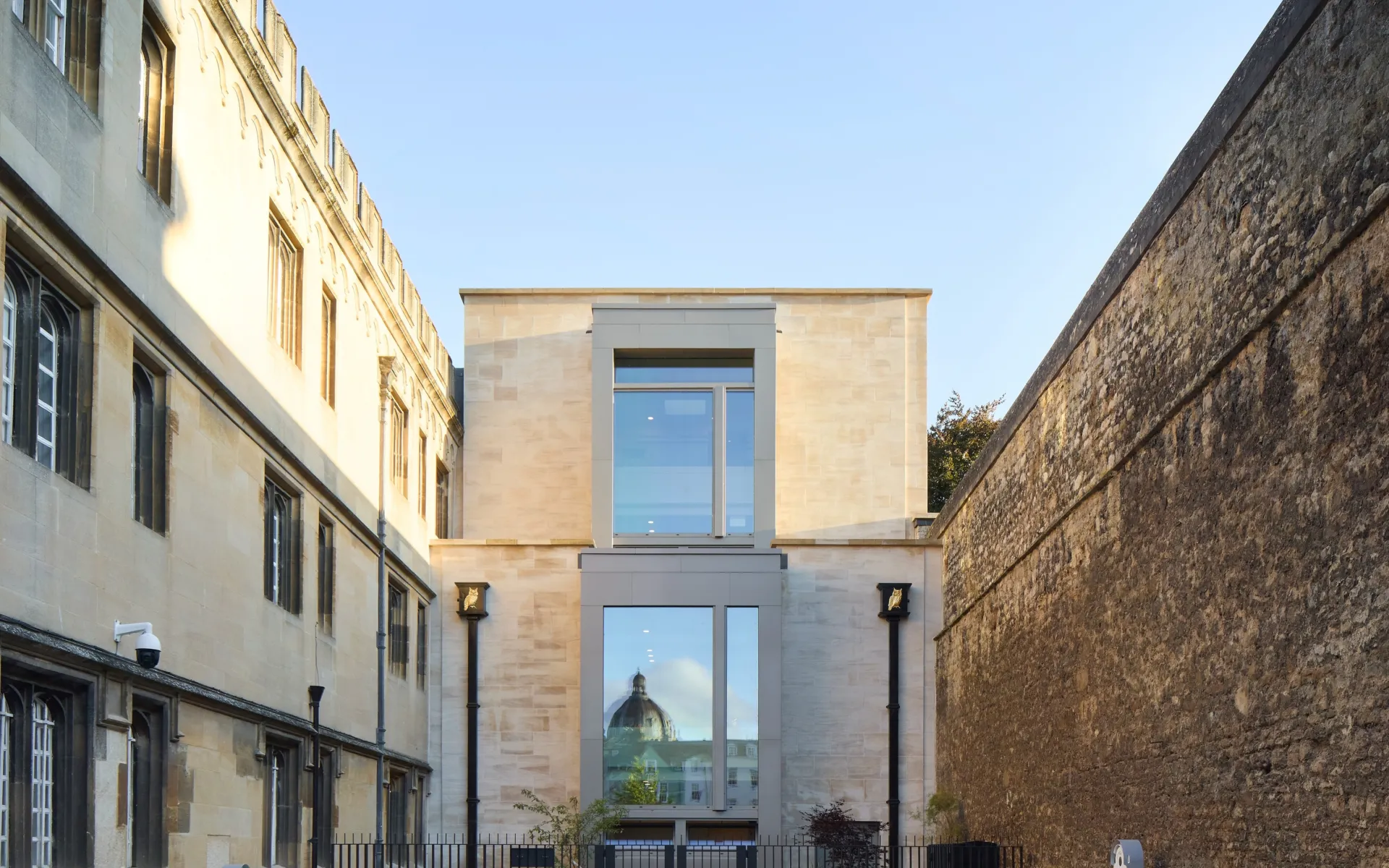
Spencer Building, Corpus Christi College, University of Oxford

The popular Everything Electric series, has highlighted the comprehensive decarbonisation of Wolfson College at the University of Oxford. The show’s host, Imogen Bhogal, visits Wolfson College and speaks with Sir Tim Hitchens, President of Wolfson College, about the motivation and process of the campus’s transformation. Home Bursar, Chris Licence, takes viewers behind the scenes to look at the transformation from gas boilers to a one-of-a-kind air source heat pump system used to heat the entire campus.
"What we've seen here today is unbelievably impressive. This is a retrofit project on steroids. The fact that there are hundreds of stakeholders, hundreds of people who live here, a grade II-listed building which introduces all sorts of complexities, and yet, they've proved that it's possible. So what's possible for other businesses and organisations that have a much more straightforward remit?"
In 2020, we worked with Wolfson College to advise on carbon-saving measures they could take to work towards their decarbonisation goals. The Grade II-listed Brutalist campus buildings had historical architectural significance but were inefficient. The listed-building status, 50-year-old gas heating system, and extensive single-glazed windows posed significant challenges to becoming a more energy-efficient campus.
Along with helping to navigate and secure Salix funding worth £5m towards decarbonisation, Max Fordham produced a comprehensive decarbonisation plan that recommended changing the single glazing to triple glazing, reusing and adapting the existing gas-fired heating system to work with electric heat pumps, replacing the roofs and installing maximum insulation, upgrading all lighting to LED, installing PVs on the new roofs, and installing a 1MWh electrical storage battery. Some of these interventions have already been completed, such as removing the gas boilers, introducing air source heat pumps and the new window installation; the rest will be implemented in later phases.
At the project's outset, the graduate college had a 20-year carbon footprint of approximately 24,000 tonnes of CO2 across its 15,000m2 gross internal area of buildings. After the extensive refurbishment, that figure reduced by more than 500 tonnes in the first year of occupation. As of January 2024, the College had no fossil fuel combustion in its buildings and is on course to achieve net zero carbon well ahead of its 2030 target.
Press coverage for projects like Wolfson College showcases positive examples for other estates considering decarbonisation, demonstrating that although every campus presents challenges and constraints, improvements can be made that significantly reduce carbon footprints, even in historic buildings.
"we got some brilliant engineers, who worked with us, they explained that we needed both a highly-sophisticated heat pump technology, but most of the effort would be going to improve our insulation"
Total of 5 images

New triple-glazed windows
© John Cairns

CO₂ compressors as part of the new air source heat pump systems - the use of CO₂ refrigerant has a lower environmental-impact
© John Cairns

Air coil to refrigerant heat exchanger
© John Cairns

The air source heat pump system
© John Cairns

Heat exchangers and a vacuum degasser
© John Cairns
"we felt, let's go big, let's make it happen quickly, and in the end it was probably about 18 months for the bulk of it to happen, and the results have been spectacular"
"we are creating an environment for young people and more senior academics to prosper in, and having a comfortable place where they're not worried about drafts, where they are able to study without putting woolly hats on, that's productivity as far as we're concerned and definitely productivity has gone up. So the results have been very very spectacular."
