Spencer Building, Corpus Christi College, University of Oxford
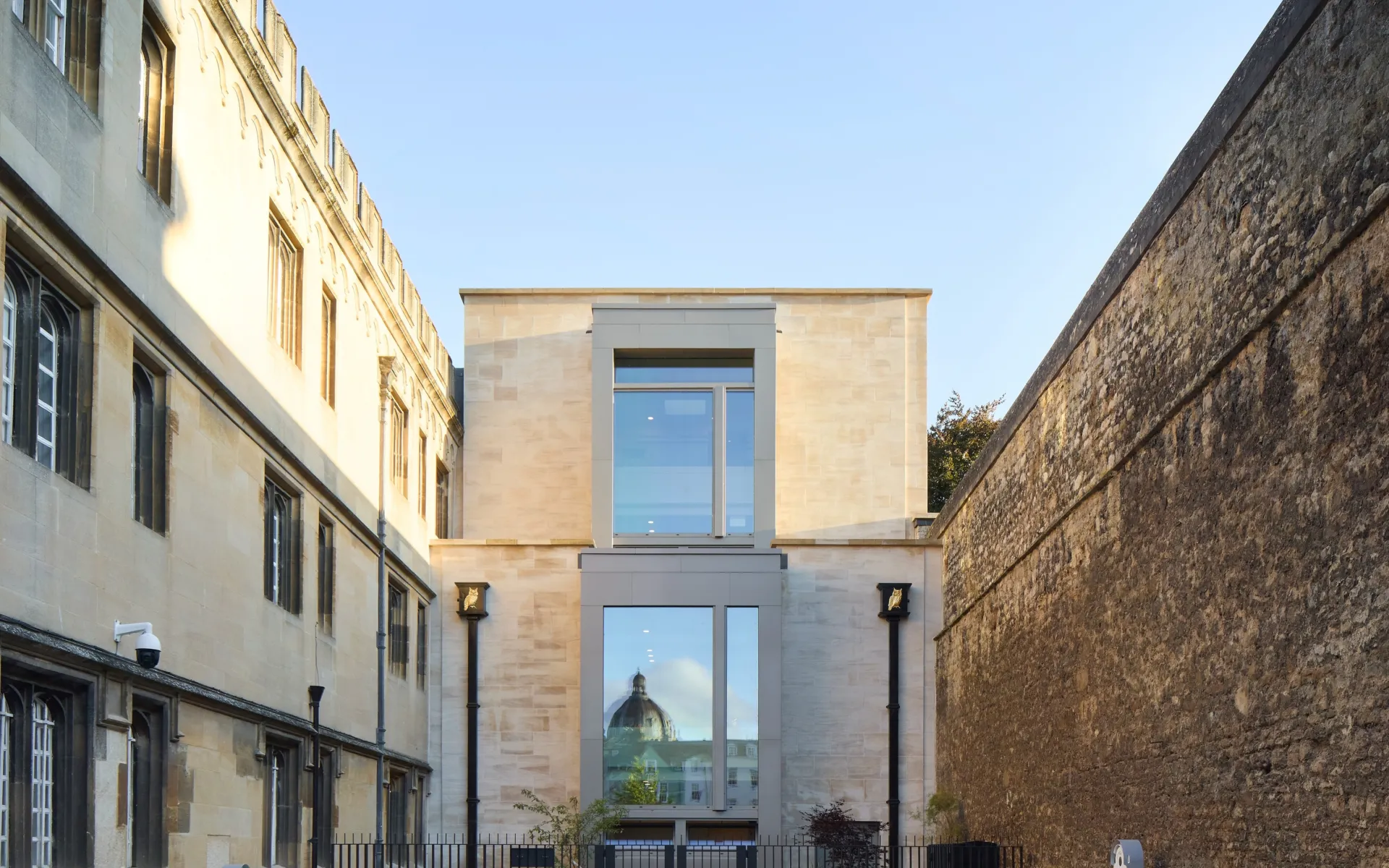

The Schwarzman Centre, designed by Hopkins Architects with Max Fordham as the M&E engineers, acoustic and lighting designers, and contractor-side Passivhaus advisors for Laing O’Rourke, is a major new cultural campus in the heart of Oxford’s Radcliffe Observatory Quarter, and the largest single building project ever undertaken by the University of Oxford. The Radcliffe Infirmary Quarter is a 10-acre site that has been under development since 2009. The centre has been developed by the University of Oxford with the support of a gift of £185 million from philanthropist and businessman Stephen A. Schwarzman.
The Schwarzman Centre will provide a unique mix of academic teaching facilities for Oxford students and staff with world-class research and performance spaces, bringing leading figures from different disciplines together to demonstrate the power of the humanities to tackle the major challenges facing society today.
The state-of-the-art spaces will co-locate Oxford University’s Humanities faculties for the first time and will also house the Institute for Ethics in AI, the Oxford Internet Institute and the new Bodleian Humanities Library. Public performance spaces include the 500-seat Sohmen Concert Hall, a 250-seat theatre to host drama and dance, a black box immersive performance space, a cinema, an exhibition space, a museum for the display of the renowned Bate Collection of historic musical instruments, and a café and a bar, all set in extensive gardens. The development comprises over 25,300 square metres of space and nearly 1,000 rooms.
Sustainability was a key design principle, and the building is on track to achieve Passivhaus certification, making it the largest Passivhaus scheme in England and the only Passivhaus concert hall in the world.
We worked closely with the design team to bring together servicing solutions for the huge variety of functions, from the concert hall right down to individual academics' studies. The services strategy, designed to Passivhaus standards, ensured ultra-low energy use and resilience to climate change through demand-controlled ventilation with heat recovery and all-electric heat pump-based heating and cooling.
Key features of the sustainable design include solar power generation installed on the roof, zero fossil fuel consumption within the building, and very high levels of insulation and airtightness to reduce the heating demand. Materials and equipment were chosen for longevity and performance, helping the building meet targets set by the university, and Passivhaus standards, for space heating demands and operational carbon emissions.
“We’re delighted the Schwarzman Centre set its sustainability ambitions to meet the rigorous Passivhaus standard. This has helped create a fresh, healthy, and light-filled environment throughout the building. It’s a great demonstration that Passivhaus can be successfully applied to many building typologies, including performance spaces, and using modern methods of construction.”

MEng PhD CEng MIMechE MCIBSE
Director, Passivhaus
Partner
Total of 3 images

©Hufton+Crow

©Hufton+Crow

©Hufton+Crow
“The Max Fordham team are proud to have played a part in the design and delivery of this impressive building from start to finish, with over 50 of our engineers having contributed along the way.”

MEng CEng MCIBSE
Principal Engineer
Partner
For the high-performance acoustic design, we employed a box-in-box strategy and isolated floors to provide superior sound insulation for key rooms, including the theatre, cinema, music studios, music ensemble and practice rooms, and ultra-quiet linguistics and phonetics research facilities. We also provided 3D acoustic simulations of critical spaces, including the Great Hall atrium.
Our approach for lighting design was to identify the key spaces, such as the Main Entrance, Great Hall and Concert Venue, where we were able to integrate lighting into the architecture to enhance its impact, whilst elsewhere we employed a simple palette of high efficiency fittings, controlled in real time across the site, to deliver appropriate light levels with minimal energy consumption.
Total of 3 images

©Hufton+Crow

©Hufton+Crow

©Hufton+Crow
“The Schwarzman Centre was a complex and ambitious project to light. It was a pleasure to be involved throughout the design and construction phases and very satisfying to see the building completed to such a high standard.“

BSc CEng MCIBSE FSLL
Director, Light & Air
Partner
Total of 6 projects


